
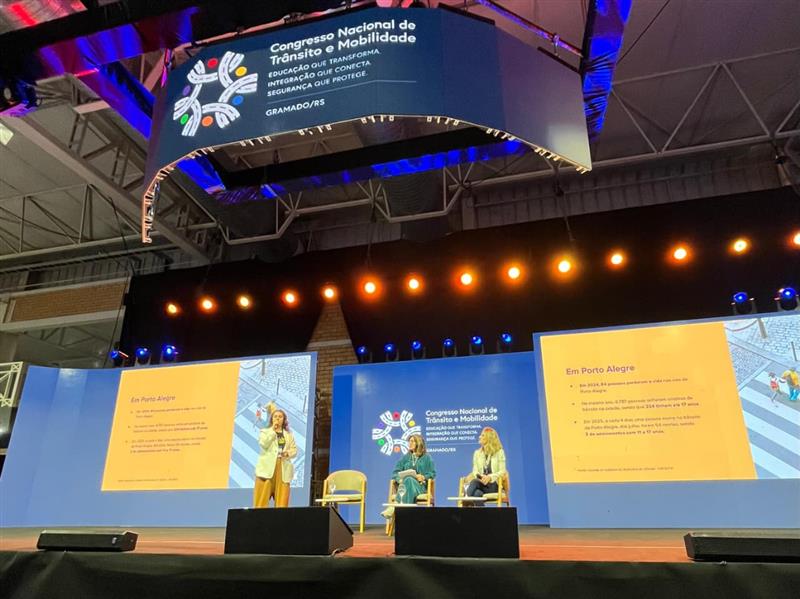
Gabriela presented the Caminho Seguro (Safe Pathways to Schools) project at the Brazilian National Congress on Traffic and Mobility (Image credit: Gabriela Teló)
Road Safety Challenges in Brazil
Brazil continues to face a significant road safety challenge. According to preliminary data from Datasus, more than 36,000 people died in road crashes nationwide in 2024. Against this backdrop, on November 18 and 19, the city of Gramado hosted the 1st National Congress on Traffic and Mobility, organized by the National Association of State Traffic Departments (AND). The Thiago Gonzaga Foundation participated alongside Ciclocidade and the Brazilian Cyclists’ Union, engaging with diverse perspectives and sharing insights on road safety.
On the second day, the Foundation presented the case of the Caminho Seguro (Safe Pathways to Schools) project and its results in reducing vehicle speeds in school zones. The session was moderated by Maria Alice Souza, Director of Road Safety at SENATRAN, with participation from Paula Manoela Santos, Mobility Manager at WRI.
The presentation began with an overview of the road safety situation in Porto Alegre, delivered by Gabriela Teló, Project and Public Policy Coordinator at the Foundation. In 2024, the city recorded 84 road deaths. Among the 6,787 injured, 224 were children and adolescents under 17. In 2025, the situation remains alarming: 61 lives have been lost, including 4 young people under 17.
Where Speed Becomes Fatal
According to the Pan American Health Organization (PAHO), reducing average speed by just 5% can decrease road fatalities by up to 30%. In Porto Alegre, of the 61 deaths recorded in 2025, 22 occurred in pedestrian crashes.
School zones have emerged as critical protection areas. For this reason, in 2025, the Foundation implemented a tactical urbanism intervention in the Cristal neighborhood, aiming to reduce vehicle speeds and improve safety for children and adolescents.
The recommended speed limit is 30 km/h, but preliminary speed measurements showed significant non-compliance. One motorcycle rider, for example, was recorded traveling at 84 km/h – a speed that would be likely be fatal in the event of a collision with a pedestrian.
During the event in Gramado, Gabriela presented results from the intervention, including:
- educational road art
- curve angle reduction using delineators
Together, these measures helped reduce car speeds by 50% in the area.
Highlighting the importance of prevention, she emphasized:
“The Foundation’s work has always been based on prevention. We need more actions that prevent road crashes. We cannot act only after lives have already been lost.”
Toward Safer Paths in Brazilian Cities
The Caminho Seguro (Safe Pathways to Schools) project, implemented in 2025 in the Cristal neighborhood, was only possible thanks to the support of FedEx Brazil and iRAP. The area has become the first school zone in Porto Alegre with safe speed.
But the challenge ahead is significant: the city has around 100 municipal schools without road safety infrastructure. For this reason, the Foundation continues articulating with potential partners who, like us, believe that reducing road fatalities begins with prevention.
Through active community listening, effective communication, mobility designs that respect how streets are used, and strong enforcement, it is possible to transform safety in our cities – one school at a time.
For further information on the Caminho Seguro (Safe Pathways to Schools) project:
- Caminho Seguro: A model for safer, more resilient school environments in Brazil
- Projeto Caminho Seguro | Zona 30 em Porto Alegre
Portuguese version of this article: Caminho Seguro: resultados apresentados no Congresso Nacional de Trânsito e Mobilidade
 English
  Português do Brasil
  Español de Colombia
  Français
  हिन्दी