
Original article and images: EASST
The EASST Coalition for Safe Routes to School is a regional initiative supported by the FIA Foundation Advocacy Hub, working to make the journeys children take to and from school safer across Eastern Europe, Central Asia and the Caucasus.
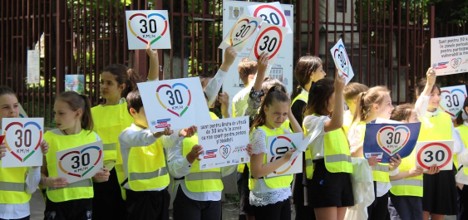
Building on five years of success (2021-2026), including the delivery of more than 1,000 reduced-speed school zones and significant policy change across a number of countries, this new phase aims to go further by strengthening links between school safety advocacy and the large-scale road and transport investments made by multilateral development banks and other international financial institutions (IFIs).
Launched in 2026, the initiative works across two areas:
- At a policy level, EASST aims to engage with IFIs to explore how child road safety principles can be more systematically reflected in major road investment projects, drawing on existing Bank protocols, tools and assessments to help maximise the safety value of road investments.
- At a project level, EASST will work with national partners to help strengthen the enabling environment needed for safe school zone measures to be included in how roads are designed, funded and delivered — supporting governments in translating existing commitments into safer streets by addressing practical barriers around standards, procurement and local delivery capacity.
To ensure the work is locally owned and sustainable, the initiative operates through a network of NGO partners and national focal points, supported by a regional Technical Forum that provides strategic guidance and supports policy change across the region.
Child-Centred Street Design
EASST has developed a Toolkit to assist EASST partners (and other interested NGOs) in identifying, assessing, and reporting on school zone safety from a child-centred perspective.
The document is designed to help them evaluate the immediate area around schools – to assess the key risks and consider interventions that could be made to improve safety for vulnerable and young road users. It signposts partners to additional resources such as iRAP Star Rating for Schools (SR4S), GDCI ‘Designing Streets for Kids’, and the Child Health Initiative ‘Traffic Conflict Technique’ toolkit. SR4S is an award-winning evidence-based programme of tools, training and support to measure, manage and communicate the risk children are exposed to on a journey to school.
The effectiveness of the SR4S methodology in advancing child road safety is demonstrated through several successful initiatives led by EASST Coalition partners:
- Budenovka school takes first steps to becoming a model for safer school zones in Kyrgyzstan
- Moldova 2025: Transforming school zone safety with 30 km/h speed limits case study
- Four school zones in Georgia get a ‘5 Star’ upgrade informed by SR4S App
The toolkit is helping EASST partners to select priority schools and work through a series of structured topics and questions (including issues such as speed management, parking, and infrastructure to name but a few) to produce a standardised written report on the current safety around an individual school to help identify areas for improvement and develop recommendations.
 English
  Português do Brasil
  Español de Colombia
  Français
  हिन्दी