
Original article: AIP Foundation
PHNOM PENH, Cambodia – July 28-31, 2026
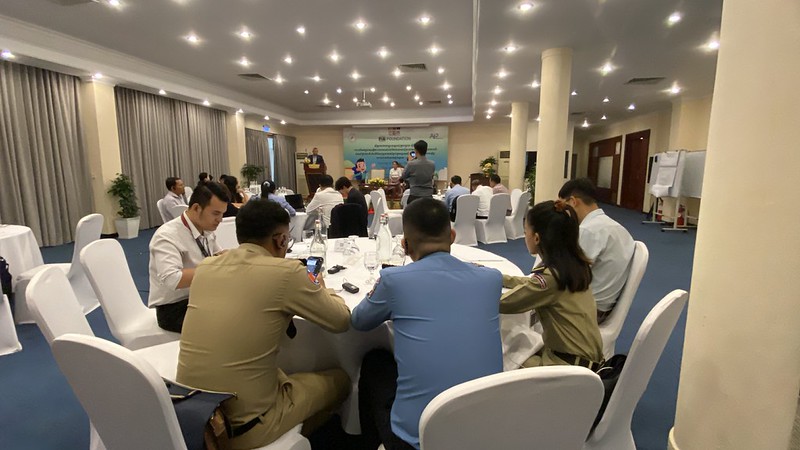
From July 28-31, a total of 38 key government officials and development partners gathered at Hotel Cambodiana in Phnom Penh to participate in a four-day Training of Trainers (ToT) Workshop on Safe School Zone (SSZ) National Guideline and the International Road Assessment Programme’s (iRAP) Star Rating for Schools (SR4S) toolkit.
The workshop brought together representatives from the National Road Safety Committee (NRSC), Ministry of Public Works and Transport (MPWT), Ministry of Education, Youth and Sport (MoEYS), Ministry of Rural Development (MRD), National Police, Multilateral Development Banks (MDB) and development partners including UNICEF and other stakeholders. The event marks a significant step toward strengthening Cambodia’s institutional capacity to improve road safety for children.
Building Capacity to Protect Young Lives
The primary objective of the workshop was to equip participants with the technical knowledge and practical tools required to plan, implement, and oversee Safe School Zone interventions, as well as to apply iRAP’s SR4S methodology for assessing road safety conditions around schools.
Participants engaged in a comprehensive program that included:
– Understanding road safety risks affecting students, particularly those studying along national and main roads
– In-depth sessions on Safe School Zone guidelines and technical interventions
– Sharing of international best practices including on the traffic law enforcement strategies in school zones and challenges from countries such as Vietnam and countries in the Africa continent
-Hands-on application of iRAP’s SR4S, including field data collection, data entry, analysis, and reporting
By combining theoretical knowledge with practical application, these activities ensured participants’ ability to immediately apply what they learned and contribute to scalable road safety improvements.
From Training to Nationwide Impact
Beyond technical learning, the workshop focused on developing a sustainable training model. Selected participants are expected to serve as core trainers, cascading knowledge and skills to provincial-level government officials, particularly in high-risk areas.
The workshop also facilitated discussions on:
– Development of training materials and lesson plans for provincial rollout
– Action planning for nationwide school safety assessments
– Strengthening engagement with infrastructure projects supported by development banks
The final day concluded with a summary of key learnings, participant commitments, post-training evaluations, and the awarding of certificates.
A Collective Effort for Safer School Zones
“This workshop represents a critical step in strengthening national capacity to improve road safety for children and youth, particularly in high-risk school zones across Cambodia,” said H.E Min Meanvy, Secretary of State of the Ministry of Public Works and Transport, Secretary-General of the National Road Safety Committee.
“The Safe School Zone is growing strength by strength, and this training represents an important new step to continue building capacity and deepening understanding. Building a strong network of trained government officials Safe School Zone interventions can be effectively implemented and scaled across Cambodia,” shared Atsani Ariobowo, Director of Child and Youth Health, FIA Foundation.
Advancing Road Safety Through Partnership
This Training of Trainers Workshop is part of the FIA Foundation-funded Safe School Zones Southeast Asia (SSZ-SEA) program, implemented by AIP Foundation and the National Road Safety Committee (NRSC). The program aims to reduce child and youth road injuries and fatalities through a combination of infrastructure improvements, policy development, and capacity building.
Through strengthened collaboration between government agencies, development partners, and technical experts, the program seeks to create safer environments for children traveling to and from school, contributing to long-term road safety improvements across Cambodia. By reducing child and youth road safety risks and integrating school zone safety into national policy frameworks and MDB-financed infrastructure systems, the program ultimately aims to set a framework that can be scaled further across the Southeast Asia region.
Useful links:
– To see more photos, please click here
– To read the press release, please click here.
 English
  Português do Brasil
  Español de Colombia
  Français
  हिन्दी